
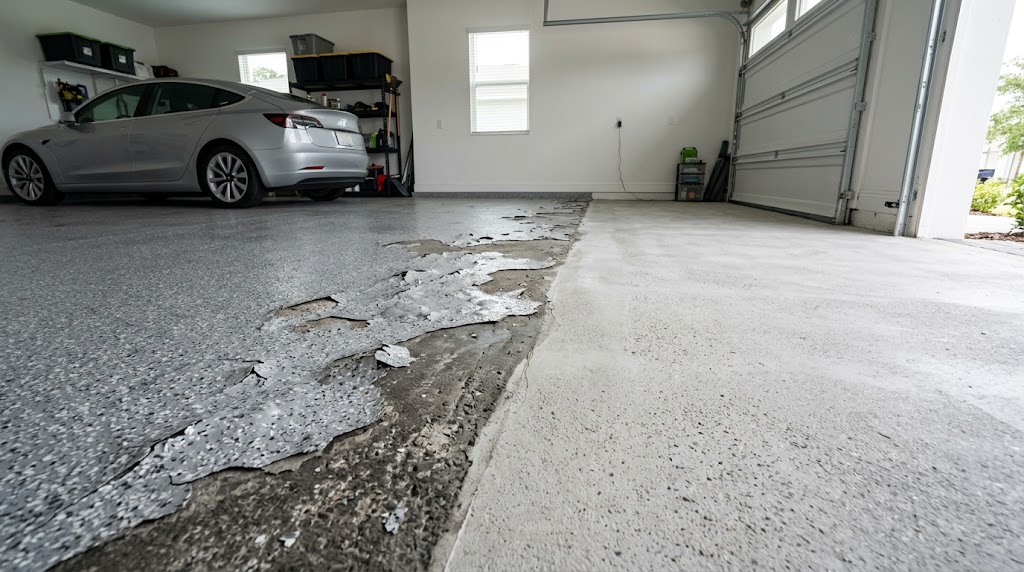
Why Is My Epoxy Garage Floor Peeling or Bubbling? Causes and Solutions
If your garage floor epoxy is peeling, bubbling, flaking, or separating from the concrete, you may be wondering what went wrong and whether the floor can be repaired.
Epoxy flooring is designed to provide a durable, attractive surface, but its performance depends heavily on the condition of the concrete, the coating system, and how the floor was prepared before installation.
When an epoxy floor starts failing, applying another coat over the damaged areas is not always the solution. The underlying cause needs to be identified before deciding how to repair the floor.
For homeowners in Titusville and throughout Brevard County, Florida, moisture, surface contamination, poor preparation, and incompatible coatings are all potential factors to investigate.
In this guide, we explain the most common reasons epoxy garage floors peel or bubble, what the warning signs mean, and when professional repairs may be the best option.
Why Is My Epoxy Garage Floor Peeling?
Epoxy garage floors can peel when the coating loses its bond with the concrete or when one layer separates from another layer in the flooring system.
Several conditions can contribute to this problem, including:
- Inadequate concrete preparation before installation
- Moisture moving through the concrete slab
- Oil, grease, or other contaminants on the surface
- Existing paint or coatings that were not compatible with the new system
- Incorrect application or curing conditions
- Excessive wear or damage from traffic and equipment
The appearance of the damage can provide clues, but it does not always reveal the exact cause. A professional evaluation can help determine whether the failure occurred between the coating and concrete or between layers of the coating system.
1. Poor Concrete Preparation
One of the first things to investigate when an epoxy floor peels is how the concrete was prepared before installation.
Concrete needs to be clean, sound, and appropriately profiled for the coating system being installed. If the surface is too smooth, dusty, contaminated, or covered with incompatible material, the coating may not develop a reliable bond.
Simply sweeping the garage or washing the concrete may not provide the preparation required for a professional epoxy system.
Why Diamond Grinding Matters
Mechanical preparation, including diamond grinding, can remove unwanted surface material and create the appropriate profile for the coating system. The exact preparation requirements depend on the product and the condition of the concrete.
If the original installer skipped necessary grinding or left behind weak material, the coating may eventually begin separating from the slab.
This is one reason Rivers Edge Painting emphasizes mechanical profiling and proper surface preparation as part of its epoxy flooring services.
2. Moisture Beneath the Concrete
Moisture is another important factor to consider when an epoxy garage floor develops bubbles, blisters, or peeling areas.
Concrete can transmit moisture vapor from the ground below, and moisture conditions can vary significantly from one slab to another. If the moisture level exceeds what the selected coating system can tolerate, adhesion problems or blistering may develop.
Florida homeowners should pay particular attention to moisture because the local climate is warm and humid for much of the year. However, humidity alone does not prove that moisture caused a particular floor to fail.
Signs That Moisture May Be Involved
Potential warning signs include:
- Bubbles or blisters beneath the coating
- Areas where the finish has lifted from the concrete
- White or chalky deposits around damaged sections
- Recurring coating failure after previous repairs
- Damp areas or visible moisture problems near the slab
These symptoms can have other causes, so they should be evaluated rather than treated as proof of a moisture problem.
Before installing a replacement system, the concrete should be assessed for moisture conditions and the appropriate testing or mitigation should be considered when necessary.
3. Oil, Grease, and Other Surface Contamination
Garage floors commonly accumulate motor oil, grease, automotive fluids, dirt, and other contaminants. These substances can interfere with the bond between a coating and the concrete.
Oil contamination can be particularly challenging because it may penetrate the concrete rather than remain only on the surface.
If a floor was coated without adequately addressing contamination, the epoxy may fail in affected areas even if the rest of the garage looks fine.
Can You Just Clean and Recoat the Floor?
Cleaning alone may not be enough if contaminants have penetrated the concrete or the existing coating has already lost adhesion.
The repair process depends on the severity of the contamination and the condition of the floor. Some areas may require mechanical preparation, specialized remediation, removal of failed material, or a combination of methods.
The goal is to address the underlying problem before installing another coating.
4. Applying Epoxy Over Old Paint or an Incompatible Coating
Another possible cause of epoxy floor failure is applying a new coating over an existing layer that cannot support the new system.
For example, if garage floor paint is already peeling from the concrete, applying epoxy over it does not fix the weak bond underneath. The new coating may remain attached to the paint while the paint separates from the slab.
The same concern applies to some existing sealers and previous floor coatings.
Before recoating an existing floor, the installer should determine what material is already present, whether it is properly bonded, and whether it is compatible with the proposed system.
If your garage floor is already painted, read our guide on whether you can epoxy over a painted garage floor.
5. Incorrect Application or Curing Conditions
Epoxy systems must be mixed, applied, and allowed to cure according to the manufacturer's requirements.
Problems can develop when the components are mixed incorrectly, the coating is applied outside the recommended environmental conditions, or the floor is exposed to traffic before it is ready.
Temperature, humidity, product selection, mixing ratios, and recoat windows can all affect the installation process.
Not every bubble or peeling area means the installer made an application error. The concrete, existing coating, moisture conditions, and product compatibility should also be investigated.
6. Heavy Traffic and Physical Damage
Garage floors experience more than ordinary foot traffic. Vehicles, toolboxes, dropped equipment, rolling loads, and abrasive debris can place additional stress on the coating.
Hot vehicle tires, sharp impacts, and dragging heavy objects can also contribute to surface damage, depending on the coating system and its condition.
However, widespread peeling or coating separation should not automatically be blamed on normal wear. If the coating is lifting away from the concrete, the underlying bond and installation conditions deserve attention.
What Is the Difference Between Peeling, Bubbling, and Flaking?
The appearance of a damaged epoxy floor can help narrow down the possible causes.
Peeling Epoxy
Peeling occurs when the coating lifts away from the surface or separates in strips or larger sections. Poor adhesion, contamination, moisture, or a weak underlying coating may be involved.
Bubbling or Blistering
Bubbles appear as raised areas beneath or within the finish. They may be associated with moisture, trapped air, application conditions, or other coating-related issues.
Flaking or Chipping
Flaking describes small pieces of coating breaking away from the floor. It may occur because of poor bonding, physical damage, or deterioration of the coating system.
Delamination Between Coating Layers
Sometimes the coating separates between layers rather than directly from the concrete. In these cases, the concrete surface itself may not be the only issue. The compatibility and application of the different layers should also be evaluated.
These descriptions are useful starting points, but the visible symptoms alone cannot confirm the cause of failure.
Can a Peeling Epoxy Garage Floor Be Repaired?
In many cases, a damaged epoxy floor can be repaired without replacing the concrete slab. Whether the entire coating needs to be removed depends on how extensive the damage is and what caused it.
A small, isolated area of damage may be repairable if the surrounding coating remains firmly bonded and the underlying problem can be corrected.
If peeling is widespread, moisture is affecting the slab, or multiple coating layers are failing, a more extensive removal and recoating process may be necessary.
When a Spot Repair May Work
A localized repair may be appropriate when:
- The damage is limited to a small area
- The surrounding coating is still well bonded
- The underlying cause has been identified
- The repair products are compatible with the existing system
Even when a spot repair is possible, matching the original color, flake pattern, and gloss may be difficult.
When the Old Coating May Need to Be Removed
More extensive preparation may be needed when:
- Large areas of epoxy are peeling
- The coating separates easily from the concrete
- Multiple layers are failing
- The existing coating is incompatible with a replacement system
- Contamination or moisture problems need to be addressed
Removing failed material allows the concrete and remaining coating to be evaluated before deciding how to rebuild the floor.
Can You Apply New Epoxy Over a Peeling Epoxy Floor?
Applying another layer directly over peeling epoxy is generally not a reliable solution because the new coating cannot correct the weak bond underneath.
If the existing epoxy is separating from the concrete, the loose or failed material needs to be addressed before a new system is installed.
If the existing coating is firmly bonded and compatible with the new system, recoating may be possible after the appropriate preparation. The correct approach depends on the coating manufacturer's requirements and the condition of the floor.
For homeowners considering a completely new installation, our guide explains how long epoxy floors typically last in Florida and which factors can affect their durability.
How Professionals Repair a Failing Epoxy Floor
The repair process should be based on the condition of the concrete and the reason the original coating failed. A typical evaluation and repair plan may include the following steps.
1. Inspect the Damaged Areas
The installer examines the peeling, bubbling, or flaking areas and evaluates the condition of the surrounding coating.
2. Identify the Likely Cause
The inspection considers surface preparation, moisture, contamination, existing coatings, physical damage, and possible application problems.
3. Remove Loose or Incompatible Material
Failed coating may need to be removed so that the remaining surface can be properly assessed and prepared.
4. Prepare the Concrete
Mechanical grinding and other appropriate preparation methods can help establish a sound surface for the replacement system.
5. Complete Necessary Repairs
Cracks, spalling, contamination, and moisture concerns should be addressed as appropriate before recoating.
6. Apply a Compatible Coating System
Once the surface is ready, the installer selects and applies a compatible system according to the manufacturer's specifications, including any required primer, base coat, decorative flakes, and protective topcoat.
Proper preparation and product compatibility are essential to reducing the risk of the same problem returning.
How to Prevent Epoxy Garage Floor Peeling
If you're planning a new garage floor or replacing a failed coating, several steps can help reduce the risk of future problems.
- Prepare the concrete properly: Use the mechanical profiling and cleaning methods required for the selected coating.
- Evaluate moisture: Determine whether moisture conditions are suitable for the proposed system.
- Address oil contamination: Identify and remediate contamination before coating.
- Remove incompatible coatings: Do not assume old paint or sealer can safely remain underneath epoxy.
- Repair damaged concrete: Address appropriate cracks, spalling, and surface defects before installation.
- Follow product specifications: Use compatible materials and observe application and curing requirements.
- Allow sufficient cure time: Follow the installer’s instructions before walking or driving on the new floor.
For more information about the installation process, see our guide to choosing an epoxy flooring installer in Titusville, FL.
Why Epoxy Floor Preparation Matters in Florida
Garage floors throughout Florida face a combination of humidity, moisture exposure, vehicle traffic, and everyday wear.
These conditions make it especially important to evaluate the concrete before installing a new floor coating. However, the right preparation and coating system depend on the actual condition of each slab rather than the climate alone.
For properties in Titusville, Mims, Port St. John, Cocoa, Merritt Island, Cape Canaveral, and surrounding Brevard County communities, an assessment of moisture, oil contamination, existing coatings, and concrete damage can help determine the appropriate approach.
Rivers Edge Painting provides epoxy flooring services for residential garages and commercial spaces, with preparation that includes diamond grinding, mechanical profiling, crack and spall repair, and evaluation of moisture and existing coatings.
How Much Does It Cost to Repair a Peeling Epoxy Garage Floor?
The cost of repairing a failing epoxy floor depends on the size of the damaged area, the cause of the failure, the condition of the concrete, and how much existing coating must be removed.
A localized repair may require less work than removing a failed coating across an entire garage. Extensive moisture remediation, oil contamination, concrete repairs, or multiple incompatible coating layers can add complexity to the project.
Before deciding whether to repair or replace the coating, have the floor evaluated so the estimate accounts for the preparation actually required.
For more information about installation pricing, read our epoxy flooring cost guide for Titusville.
Frequently Asked Questions About Peeling Epoxy Floors
Why is my epoxy garage floor peeling after only a few months?
Early peeling can be associated with poor surface preparation, contamination, moisture conditions, incompatible coatings, or application and curing problems. The exact cause needs to be evaluated before deciding on a repair.
Why is my epoxy floor bubbling?
Bubbling can result from moisture-related problems, trapped air, application conditions, or other issues within the coating system. An inspection can help determine which cause is most likely.
Can I fix peeling epoxy myself?
Small repairs may be possible for experienced DIY homeowners, but the damaged material must be removed appropriately and the underlying cause addressed. Recoating without correcting the problem can lead to another failure.
Does peeling epoxy mean my concrete is damaged?
Not necessarily. Sometimes the coating fails while the concrete remains sound. However, the exposed slab should be inspected for cracks, spalling, contamination, and moisture concerns before repairs begin.
Will a new coat of epoxy fix bubbling?
Not by itself. The cause of the bubbling needs to be identified, and failed material or underlying moisture problems may need to be addressed before applying a replacement coating.
Can epoxy flooring be repaired without grinding?
Some repairs may require different preparation methods depending on the product and damage, but mechanical grinding is commonly used when substantial coating removal or concrete profiling is necessary. The correct method depends on the condition of the floor and the new coating system.
How long should an epoxy garage floor last?
The lifespan depends on the coating system, concrete preparation, installation quality, traffic, maintenance, and environmental conditions. A properly installed system can last many years, but recurring peeling or bubbling should be investigated rather than ignored.
Get Help With Your Epoxy Garage Floor in Brevard County
If your garage floor is peeling, bubbling, or flaking, the best next step is to identify why the coating is failing before investing in another layer.
Rivers Edge Painting helps homeowners and businesses throughout Titusville and Brevard County evaluate concrete conditions and prepare surfaces for epoxy flooring systems.
Whether you're dealing with a failing coating, worn concrete, oil stains, or a garage floor that needs a complete upgrade, proper preparation is an important part of choosing the right solution.
Contact Rivers Edge Painting for a free epoxy flooring estimate.
Visit our epoxy flooring service page to learn more, or call (321) 291-1216 to discuss your project.
We serve Titusville, Mims, Port St. John, Cocoa, Merritt Island, Cape Canaveral, and surrounding Brevard County communities.